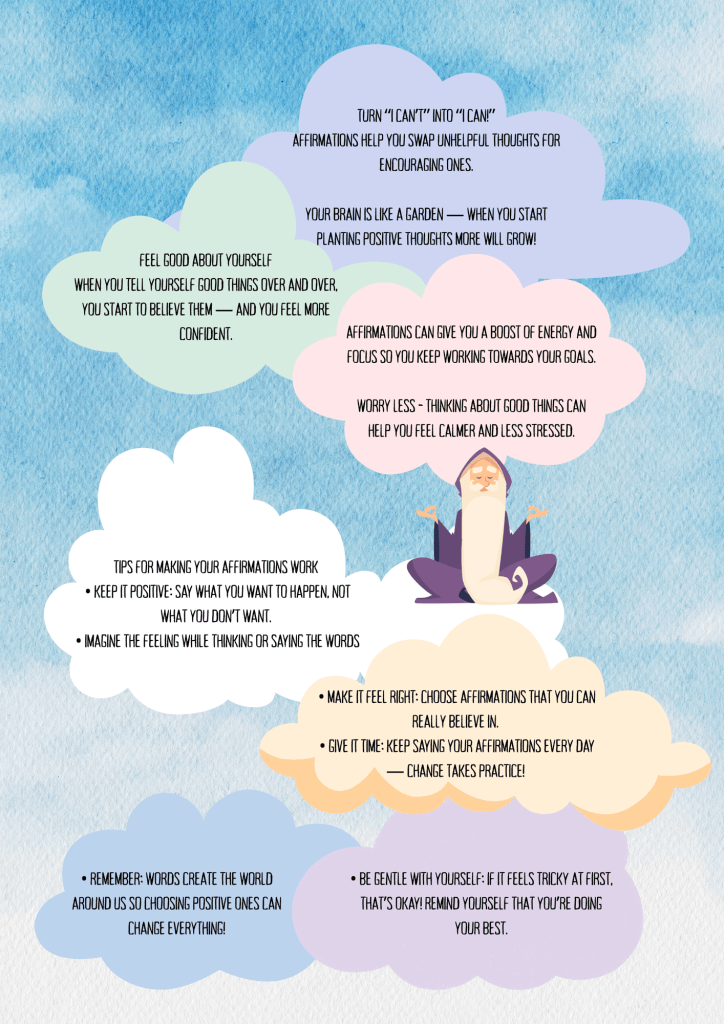
If you’ve ever caught your child saying, “I’m rubbish at this,” or “I can’t do it,” you’ll know just how powerful those little voices in our heads can be. The good news is that positive self-talk is a skill children can learn. In one study, researchers found that children who practised effort-focused self-talk—saying things like “I’ll do my very best”—performed better at maths than children who didn’t use self-talk, especially those who lacked confidence in their abilities. It wasn’t about pretending to be the best; it was about encouraging themselves to keep trying. For older kids telling them about the research will also blow their mind: positive thoughts can be a superpower!
What they did
- Studied 212 children aged 9–12 years
- The children completed part of a maths test and were then randomly assigned to one of three groups:
- Effort self-talk: “I will do my very best!”
- Ability self-talk: “I am very good at this!”
- No self-talk
- They then completed the second half of the test.
What they found
Children who already doubted their abilities performed better after using effort-focused self-talk than children in the other two groups. Interestingly, simply telling themselves “I’m very good at this” didn’t have the same effect.
Here’s my magical positivity printable for more ideas: https://cocorockpaper.etsy.com/listing/4369833125
Thomaes, S., Tjaarda, I. C., Brummelman, E., & Sedikides, C. (2020). Effort Self-Talk Benefits the Mathematics Performance of Children With Negative Competence Beliefs. Child Development, 91(6), 2211–2220.
 Isle of rainbows
Leave a comment